Stamnos Pottery of Ancient Greece

Stamnos Pottery of Ancient Greece

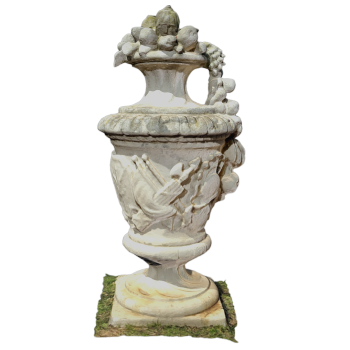
Stamnos is a form of pottery common in ancient Greece and Rome, often used to hold wine or other liquids. This exhibit is now in the Museo Palazzo Corboli (Colbury Palace Museum).
Zeus head stone carving

Zeus head stone carving

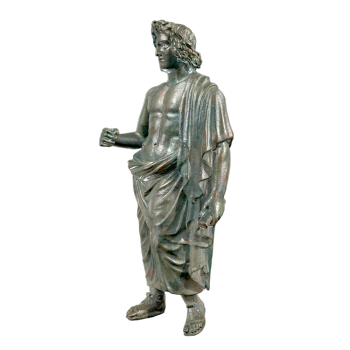
It is the king of the gods in ancient Greek mythology and the head of the twelve gods of Olympus. The god of the sky and thunder and lightning, with thunderbolt as a weapon, maintains the order between heaven and earth. He is the son of the second generation god king Cronus of the Titan clan, whose mother is Ria. To avoid the fate of being devoured by Cronus, he was hidden by his mother and raised in Crete or by the Goddess Nimve. As an adult, Zeus rescued his brothers and sisters who had been devoured by his father and fought with them against Cronus, eventually overthrowing the rule of the Titans. Known for his wisdom and strength, his reign symbolized the rise of the new theocracy and the fall of the old. play a supreme role in mythology
Statue of Nike, the Greek goddess of victory

Statue of Nike, the Greek goddess of victory

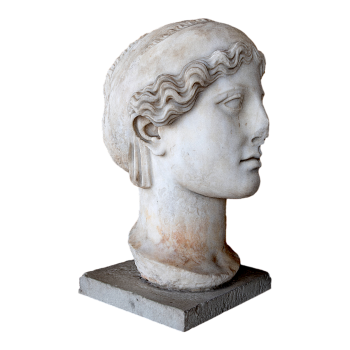
Niki (Greek: Νίκ η, "victory"; Latin transliteration: Nike) is the goddess of victory in Greek mythology, corresponding to Victoria in Roman mythology. According to Hesiod's Theogony, she was the daughter of the Titan gods Pallas and Styx, as well as the sister of Kratos (power), Biya (strength), and Zeros (passion), all of whom were companions of the main god Zeus. Despite coming from the Titan tribe, she still stood by the side of the Olympian gods in the Titan Wars, bringing them victory.
3D model of griffin with animation

3D model of griffin with animation

It is a mysterious creature derived from ancient myths and legends, combining the body of a lion with the head, wings, and front paws of an eagle. It is usually depicted as possessing the strong body of a lion and the sharp gaze of an eagle, a combination of strength and wisdom. In ancient Greek and Roman mythology, the griffin was a symbol of wealth and power, often carved on temples and coins as the incarnation of a guardian deity. It is considered a creature that guards treasures and treasures, and also symbolizes the divine guardian. It was also very popular in medieval heraldry, often used by nobles and knights as part of their family crest to showcase their nobility and bravery.
Late Minoan period II to III ceramic containers

Late Minoan period II to III ceramic containers

It is an ancient Greek ceramic container characterized by a unique decorative style, often associated with palace workshops in Crete. This style of pottery appeared during the late Minoan period II to III (approximately 1450 BC to 1100 BC) and is representative of the late Minoan civilization. Known for its exquisite decorations, especially the papyrus flower patterns depicted above, these decorations not only showcase superb craftsmanship but also reflect the culture and aesthetics of the society at that time. The prototype was discovered in Knossos, which was one of the centers of the Minoan civilization. It is a valuable resource for studying ancient Mediterranean world trade and cultural exchanges.
Linear octopus patterned stirrup jar

Linear octopus patterned stirrup jar

It is a type of pottery from the late Minoan civilization on the island of Crete in ancient Greece. This jar is named after its unique stirrup shape and is decorated with a linear octopus pattern. The Minoan civilization, approximately from 2000 BC to 1450 BC, was one of the earliest civilizations in Europe, known for its complex palaces, religious beliefs, and artistic achievements. The stirrup jar is one of the common pottery items in the Minoan culture, typically used for storing food and liquids. The shape design makes them easy to carry and use, while the decorative patterns reflect the Minoan people's worship of nature and marine life. It is the material cultural heritage of the Minoan civilization.
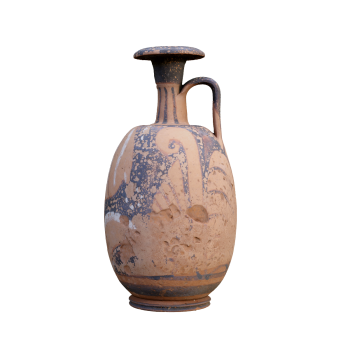
Lekythos Ancient Greek Ceramic Container - Igleio Archaeological Museum
Lekythos Ancient Greek Ceramic Container - Igleio Archaeological Museum

It is a kind of ancient Greek ceramic container, usually used to hold oil, perfume or condiments. It has a cylindrical body, a narrow neck and deep mouth, and a handle extending from the shoulder to below the neck. Usually used as burial objects for the deceased. In the classical period, especially in the 5th century BC, this type of container was very popular in Athens, possibly derived from the shape of Corinth. Discovered at the Kamarina site in Sicily, Italy, it is a product of the classical period, made around the 5th century BC. It is currently housed in the Igleio Archaeological Museum in Ragusa. This provides valuable physical evidence for us to understand ancient Greek culture and religious customs.
Small Ceramic Containers from Ancient Greece - Collected by the Ragusa Archaeological Museum

Small Ceramic Containers from Ancient Greece - Collected by the Ragusa Archaeological Museum
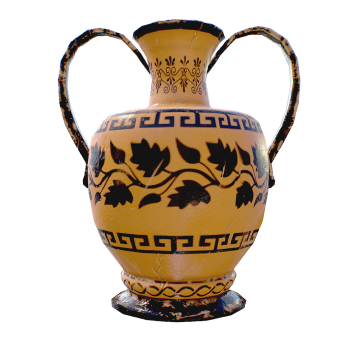
It is a small container in ancient Greece, usually used to hold perfume or oil, especially when athletes are bathing. Compact in shape, spherical or spherical in shape, with a narrow neck. The origin can be traced back to the classical period, around the 5th century BC. In the city of Ragusa on the island of Sicily, Italy, there is an archaeological site called Camarina, where a ceramic container belonging to the classical period has been unearthed and is now housed in the Ragusa Archaeological Museum. Featuring exquisite craftsmanship and possible decorative patterns, it reflects the artistic style and aesthetics of ancient Greece. It is a daily item in ancient Greek culture and a reflection of art and craftsmanship.
Greek neck bottle

Greek neck bottle

It is a ceramic container from ancient Greece, with an iconic long neck and two vertical handles, usually located on the shoulders. This dual ear bottle design is very suitable for carrying and pouring liquids such as oil, wine, or water. Greek necklaces not only have a wide range of uses in daily life, but also play an important role in religious ceremonies and funerals. They are often used as burial objects in tombs to hold liquids for worship. The surface of Greek neck vases is often painted with exquisite patterns, including mythological scenes, battle scenes, or daily life scenes, providing us with a window to understand ancient Greek culture and art.
Greek Vase

Greek Vase

Greek vases are a type of ceramic container in ancient Greek civilization, known for their exquisite decoration and historical value. These vases are usually made of clay and have black or red patterns painted on the surface, reflecting the life scenes, mythological stories, and religious rituals of ancient Greeks. The design of Greek vases is diverse, including double ear vases, water bottles, oil tanks, etc., each with its specific purpose. They are not only daily necessities, but also carriers of art and cultural heritage. The exquisite painting and carving techniques on Greek vases showcase the superb skills of ancient Greek artists. These vases are still important resources for studying ancient Greek culture and art to this day.
Anfu Lagu Greek Ceramic Container - Baltimore

Anfu Lagu Greek Ceramic Container - Baltimore

It is a container from ancient Greece, named after the Greek words "Amphi" (meaning "both sides") and "Pero" (meaning "to carry"). This container has two vertical handles on each side, connecting the bottle mouth or neck to the bottle body. It is mainly used for storing and transporting solids and liquids, especially closely related to the transportation of wine and olive oil. In the Attica region around 400 to 375 BC, an Athenian painter created an artwork depicting the struggle between Poseidon and Athena for Attica land. This work is currently stored in Baltimore.
Hidria Ancient Greek Ceramic Container - Paul Getty Museum

Hidria Ancient Greek Ceramic Container - Paul Getty Museum

Greek for ὑδρία, it is an ancient Greek ceramic container primarily used for storing and transporting water. The characteristic of this ceramic is that it has three handles: two horizontal side handles for lifting the container, and a vertical rear handle for pouring the contents. Around 550 BC, a hidria was produced in the Attica region, depicting scenes of Dionysus, Ariadne, and Poseidon. This artwork is currently housed in the Paul Getty Museum. This ancient Greek ceramic work not only showcases the craftsmanship of the time, but also reflects Greek mythology and religious beliefs.
P í xie Ancient Greek Small Container

P í xie Ancient Greek Small Container

It is a small container from ancient Greece, usually used to store personal belongings. During the period of 490-480 BC, this container was decorated with the technique of "black pattern". It depicts a mythological scene of Athena and Poseidon competing for land in Attica. In the scene, Kekropus serves as a witness, accompanied by two knights, while a female figure runs towards the olive tree created by Athena. This scene not only showcases the mythological stories of ancient Greece, but also reflects the identity and cultural values of the Athenians.
Ancient Greek Cantalos ceramic wine vessel

Ancient Greek Cantalos ceramic wine vessel

It is a common ceramic wine vessel in ancient Greece, with a unique design that features double ear handles and a wide mouth, making it easy to pour and drink. The design aims to facilitate drinking, while its artistic and decorative qualities also reflect the aesthetic pursuit of ancient Greek culture. Often used in banquets and religious ceremonies, it was an indispensable part of ancient Greek social life. The decorative patterns are rich and diverse, including mythological stories, battle scenes, and daily life scenes. These patterns not only beautify wine vessels, but also convey the culture and values of ancient Greece.
Ancient Greek Terracotta Vase

Ancient Greek Terracotta Vase

The terracotta vases of ancient Greece are outstanding representatives of ancient art and craftsmanship. These vases are usually made of red clay, a type of clay that has been fired at high temperatures and has a hard and durable texture. The ancient Greeks used these vases to store liquids such as wine, olive oil, and water, as well as for religious ceremonies and as burial objects. The ancient Greek terracotta vase not only played an important role in practicality, but also an important component of Greek culture and social life. They reflect the aesthetic concepts, religious beliefs, and social customs of ancient Greeks, and are valuable materials for studying ancient Greek civilization.
Anfula vase

Anfula vase

Originating from the pottery containers of ancient Greece and Rome, they are renowned for their unique double ear design and are commonly used for storing and transporting liquids. In Barcelona, the design of this ancient container is reinterpreted by modern artists and designers, creating decorations that have both classical charm and modern aesthetics. The Anfula vase in Barcelona blends the city's rich historical and cultural heritage with modern art styles. These vases are not only displayed as artworks, but also commonly used to decorate spaces, adding beauty and cultural atmosphere to the interior.
Alabasteron Ancient Greek Pottery - Paul Getty Museum

Alabasteron Ancient Greek Pottery - Paul Getty Museum

It is a type of ancient Greek pottery, named after the Greek word "ἄλαβ στρον", referring to an elongated container with a rounded bottom and a lid at the mouth. The name and shape may originate from Egypt and have the same name as the stone used to make this container. It is usually used to store oils, especially perfume used by women after bathing. This specific Alabasteron was produced in the Attica region and can be traced back to 490 to 470 BC. The scene depicted on the container is a person holding a bow and arrow and an axe, with palm trees in the background. Currently housed in the Paul Getty Museum. It is an important cultural relic for studying the daily life and artistic style of ancient Greece.
Collins Bowl - Bonn University Academic Art Museum

Collins Bowl - Bonn University Academic Art Museum

The Corinthian bowl collected by the Academic Art Museum of the University of Bonn is an ancient Greek pottery dating back to around 575 BC, representing the pinnacle of pottery production during the Corinthian period. The excavation location of this bowl is unknown, but its exquisite craftsmanship and decoration showcase the superb skills of ancient Greek potters. The bowl wall is very thin, the bottom is low, the belly is spherical, the mouth edge is noticeably outward sloping, and there are handles installed horizontally on both sides. The bowl is adorned with a circular decorative strip, with two to three groups of warriors depicted on one side and riders galloping to the left on the other side. These patterns not only beautify pottery, but also reflect the wars, myths, and nature worship of ancient Greek society
Collins style wine jug - Academic Art Museum of Bonn University
Collins style wine jug - Academic Art Museum of Bonn University

A Corinthian wine jug, collected at the Academic Art Museum of the University of Bonn, is a pottery piece produced in Corinth between 625 BC and 600 BC. Collins was a leader in pottery production at that time, and its products were widely exported throughout the Mediterranean region. The specific location where this pottery was unearthed is unknown. It is a pot with a three leaf shaped mouth edge and a sometimes upturned strap handle, which connects the mouth edge and shoulder. The black painting technique invented by Collins was used for drawing. It is an important type of ancient Greek pottery, and its design and decorative style reflect the prosperity of Greek culture and art.
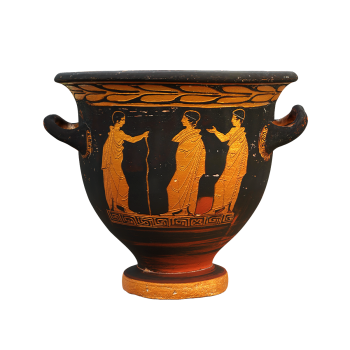
Attic Red Pottery Bottle - Bonn University Art Museum

Attic Red Pottery Bottle - Bonn University Art Museum

It is a masterpiece of ancient Greek pottery art, currently housed in the Bonn University Art Museum. Known for its unique shape and decorative style, it is characterized by patterns drawn with black or dark brown pigments on reddish brown clay, creating sharp contrasts. It usually has a wide mouth rim and a downward contracting neck, shaped like an inverted bell, hence the name "Bell Ceramic Bottle". In ancient Greece, it was widely used to mix water and wine, and was an indispensable container for banquets and social events. The patterns on the bottle usually depict mythological stories, daily life scenes, or animals, and these intricate paintings showcase the superb skills of ancient Greek artists.
Minoan vase

Minoan vase

The Minoan vase is a ceramic artwork from the Minoan period of ancient Greek civilization, which existed approximately between 2600 BC and 1100 BC. The Minoan civilization is one of the earliest civilizations in ancient Greece, mainly located on the island of Crete and later on the Greek mainland. The Minoan vase is an important symbol of cultural and artistic achievements during this period. The Minoan vase is renowned for its exquisite craftsmanship and decoration. They usually have smooth lines and elegant forms, decorated with complex geometric patterns, marine creatures, plants, and mythological scenes.
Bonn University Academic Art Museum Ancient Greek Pottery

Bonn University Academic Art Museum Ancient Greek Pottery

A piece of ancient Greek pottery collected in the Academic Art Museum of Bonn University. This bowl is said to have been discovered at the Diplon Gate in Athens, around 750 BC to 735 BC, and was produced in the Attica region. This vessel is characterized by steep edges and a horizontal band like handle. The upper wall is divided into panels with stars, Capricorn, swastika, and checkerboard patterns. The wide stripes between the handles are divided into three panels: a display zigzag band in the middle and birds on both sides. The handle itself is also decorated with a zigzag band. It is an outstanding representative of ancient Greek pottery art and an important physical evidence for studying ancient Greek culture and artistic style
Prototype Geometric Lequitos Bottle

Prototype Geometric Lequitos Bottle

It is an ancient Greek pottery, collected in the Academic Art Museum of Bonn University. This Lechitos bottle can be traced back to the prototype geometry period of the 9th century BC and was made in the Athens region. Known for its simple geometric patterns and decorative style, these patterns typically include lines, circles, and simple shapes. As a typical representative of this period, it showcases the skills and artistic aesthetics of ancient Greek ceramic artists. These pottery bottles are not only practical containers, but also valuable materials for studying ancient Greek culture and religious customs.
Saint Valentine's Cup

Saint Valentine's Cup

It is an ancient Greek pottery cup collected by the Academic Art Museum of Bonn University, dating back to the late 5th century BC or early 4th century BC. Belonging to the so-called Saint Valentine Cantalos Cup category, it is characterized by a bell shaped body and a vertically installed handle that connects the rim of the cup to the lower part of the cup body. It may have been produced based on the prototype of Attica in Attica or Apulia region. Each side has decorative panels, with Ionic vortex patterns on the upper and lower edges, and the middle area filled with laurel and ivy wreaths and dotted lines. It showcases the exquisite craftsmanship of ancient Greek pottery and reflects the aesthetic style of the time.
1 2 Next